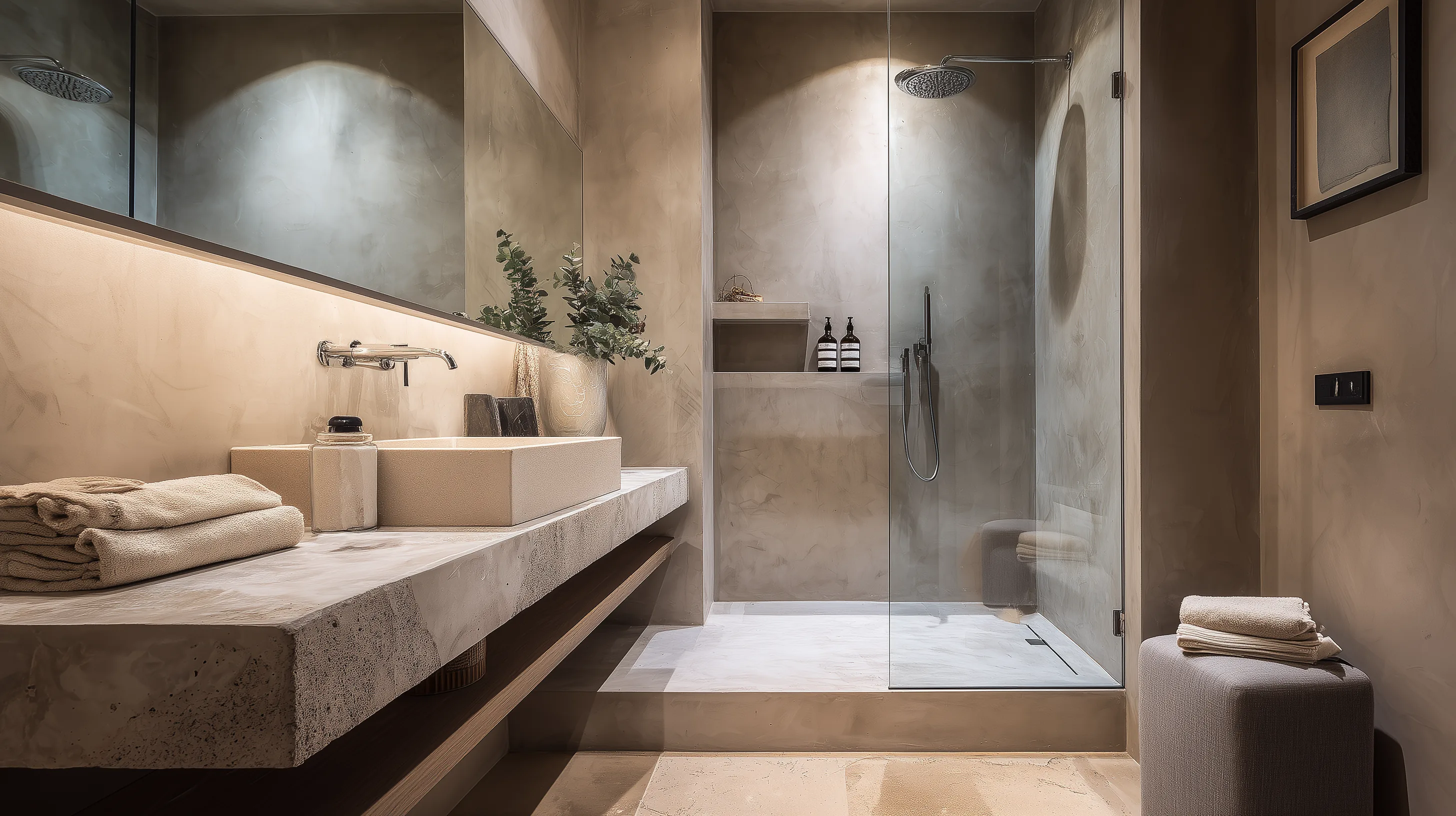
Most people come to us because they're standing in a bathroom full of tired, dated tile and dreading what comes next. They've started getting quotes. They've heard the words "jackhammer," "skip bin," and "four to six weeks." And then someone mentions microcement, and everything changes.
Microcement is a thin, layered cement-based finish. Some existing floors or walls may be suitable for an overlay after adhesion, movement, moisture, height, transitions, and preparation requirements are reviewed. Removal or repair may still be necessary.
For Vancouver Island renovations, microcement may be considered when a continuous cement-look surface is the design goal. This article outlines potential advantages and the conditions that must be reviewed before those advantages apply.
1. A Possible Overlay Instead of Automatic Demolition
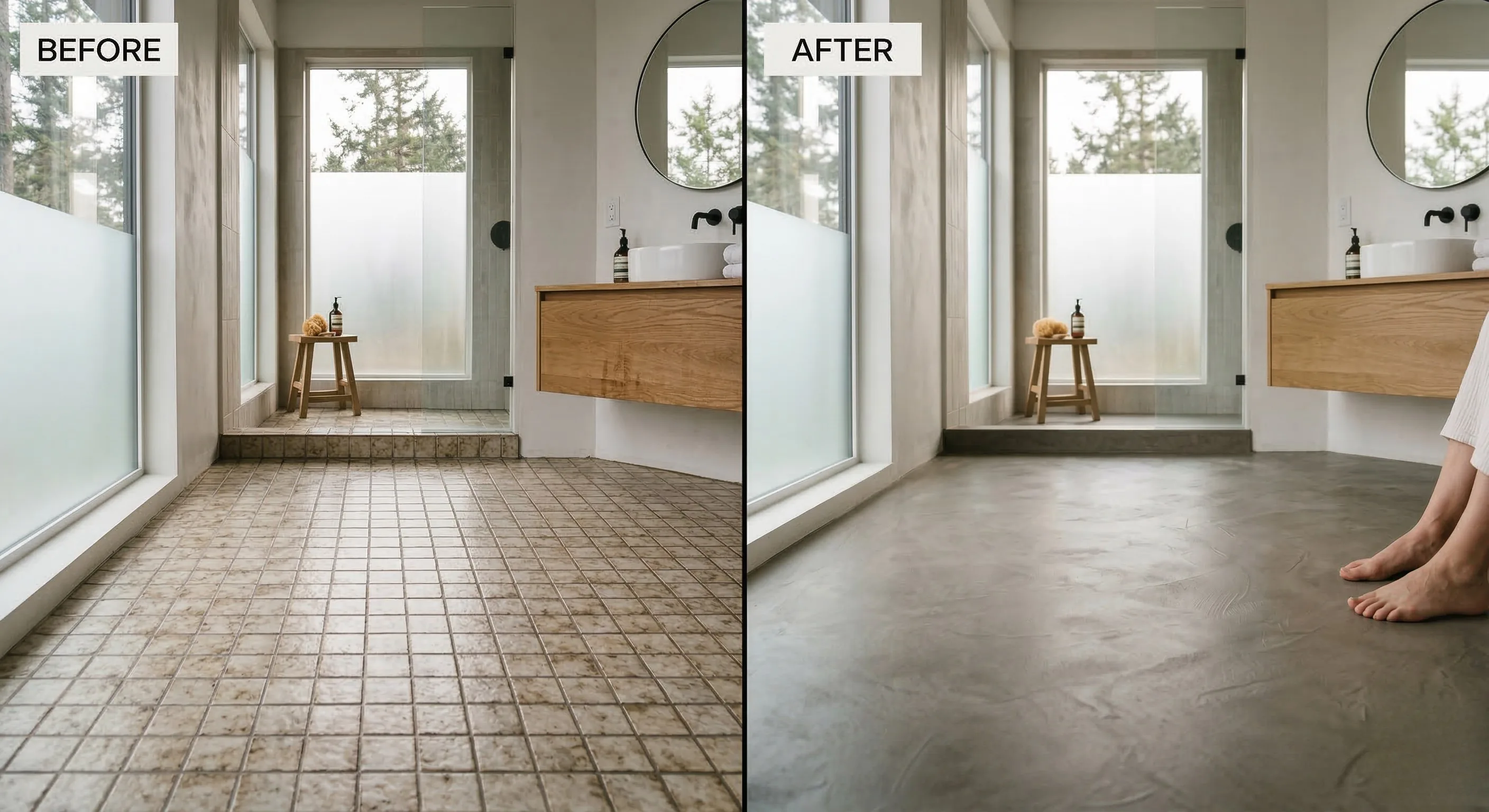
Some sound tile, concrete, or plywood assemblies may be candidates for an overlay. The decision depends on bond, movement, moisture, cracks, grout lines, height changes, transitions, heating, and the written requirements of the selected system. Unsuitable surfaces still require removal, repair, or work by another trade.
When you start adding up the "hidden" costs of a traditional tile demo — labour, disposal fees, subfloor repairs, new baseboards — you're often looking at $3,000–$5,000 before a single new tile goes down. With microcement, that money stays in your pocket. We're building up, not tearing out. See how microcement compares to tile.
2. Seamless — and That Matters More Than You Think
One of the most common complaints we hear from clients with existing tile? Grout. Specifically, the relentless, losing battle of keeping grout lines clean in a bathroom or kitchen. Grout cracks. Grout stains. Grout makes a floor look old before its time.
Microcement has no grout lines. It's one continuous surface from wall to wall — that "hotel spa" look you see in high-end design magazines. Practically, this means you wipe the whole surface down in one pass. It also means fewer grout-related cleaning issues in a West Coast bathroom where humidity is a daily reality.
3. It's Warmer and More Textured Than It Looks
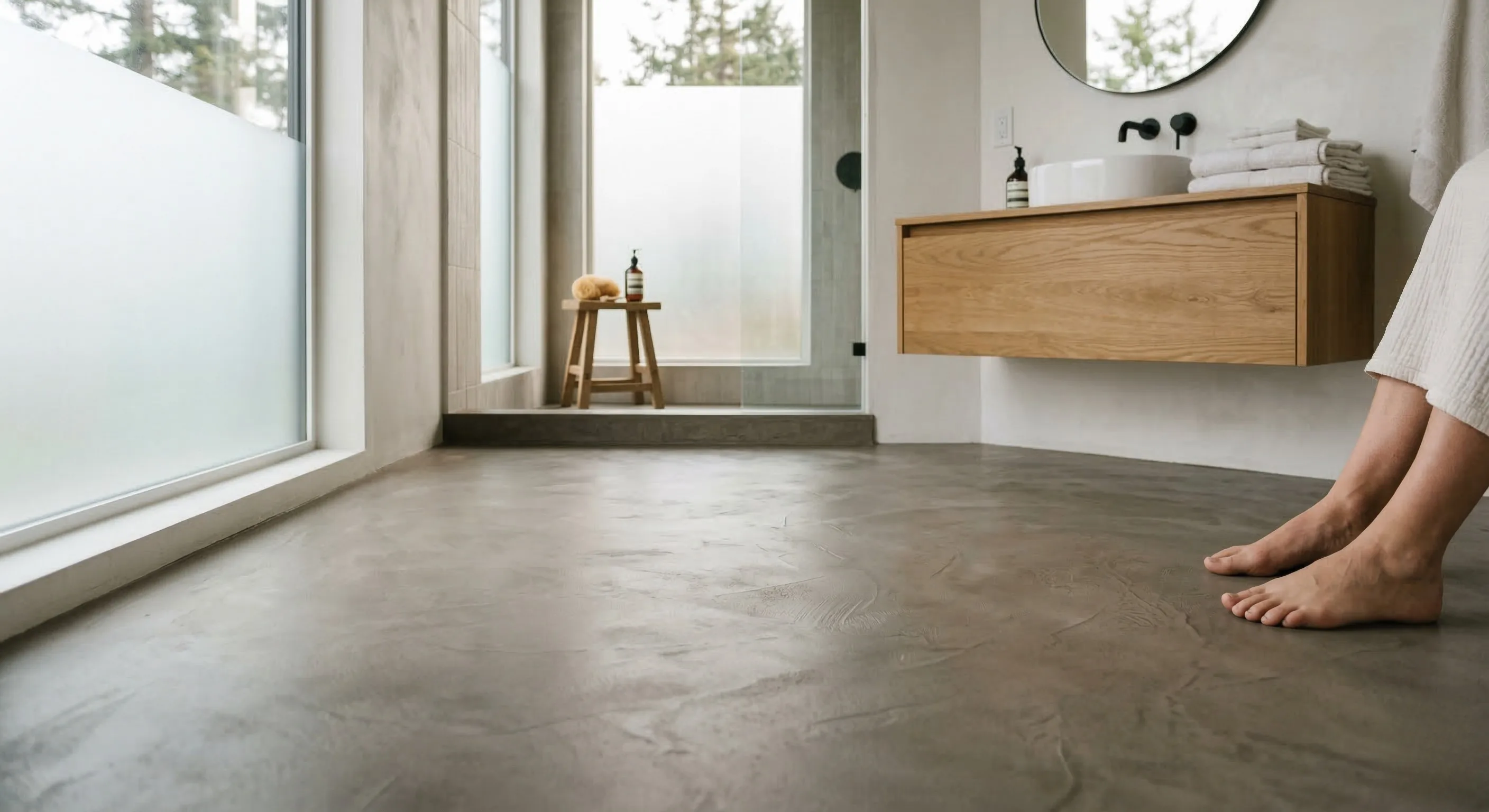
This is the thing that surprises almost everyone after installation. Most people see photos of microcement and assume it'll feel like a cold, hard sidewalk underfoot. It doesn't.

Because microcement is so thin and bonds directly to the substrate beneath it, it picks up the ambient temperature of the room far better than a thick slab of concrete or stone. Walk on it in bare feet on a winter morning and you'll notice the difference immediately.
The other surprise is the visual depth. In photos, it looks like a flat, solid colour. In person — especially with the natural light we get on the Island — you see the subtle trowel marks and layered shading that make it look more like leather or suede than rock. It's a living surface. It has what I'd call "soul."
Texture can be discussed during sampling, but wet-area slip performance should be specified and verified for the complete system and intended room use rather than assumed from appearance.
4. Built for Wet West Coast Conditions
Every floor system responds differently to moisture, movement, impacts, cleaning, and maintenance. The visible finish alone does not replace the need to identify and control water or substrate problems.
A correctly specified microcement system can create a continuous sealed finish with fewer grout lines. Wet-area use still depends on the underlying waterproofing, substrate, movement, transitions, drains, sealer maintenance, and the written instructions for the selected product system.
Microcement may be considered for suitable bathroom surfaces when the complete assembly and product system are specified correctly. Explore microcement textures and finish directions.
5. A Bespoke Finish You Can't Buy at Home Depot
Every microcement floor is hand-applied and one of a kind. The colour, the finish, the texture — it's all specified for your space and your taste. You can't walk into a warehouse and pull it off a shelf.
A medium grey with a cloudy finish is one sample direction worth exploring. It can suggest raw concrete while allowing visible hand-trowelled variation; the final colour and movement should be approved from a project sample.
For spa-style bathrooms, Off-White or Bone is a favourite. It makes a small, dark bathroom feel massive and airy — and the "wow" factor when the sealer goes on is genuinely something to see.
6. Where It Makes the Most Sense (And Where It Doesn't)
Microcement may be a useful option in specific situations. Possible fits to review:
- Bathroom or kitchen renovation over suitable existing tile — may reduce removal and disposal when the complete assembly qualifies.
- Modern-industrial builds with open floor plans where you want one continuous surface running through every room.
- Bathroom or laundry surfaces: only where the complete assembly, room details, product system, and responsibilities are suitable and documented.
Where it's not the right call:
- Heritage homes with bouncy, original timber floorboards — significant flex in the substrate will eventually cause issues even with mesh reinforcement.
- High-traffic commercial kitchens where heavy crates are dropped and dragged daily — in those cases, industrial epoxy is the better tool.
- Clients who want a perfectly uniform, "printed" look. Microcement has natural variation — shading, trowel marks, depth. If you want a floor that looks like a sheet of plastic, this isn't it.
7. The Cost Question — Answered Honestly
Microcement isn't the cheapest option upfront. It's a multi-stage, handcrafted process: prep, priming, base coats, mesh reinforcement, fine finish coats, sanding, and multiple layers of high-end sealer. That labour is real, and it's reflected in the price.
But here's how we explain the value to clients who push back:
Look at the total cost, not just the install cost
Your tile quote probably doesn't include the skip bin, the jackhammer labour, the subfloor repair, or the new baseboards. Once you add those in, the gap between microcement and a tile renovation narrows significantly — and often disappears entirely.
Fewer grout-related weak points
You're not paying for cement alone. You're paying for a layered, flexible finish system with no grout lines, fewer grout-related cleaning issues, and a surface that is specified for the room instead of pulled from a shelf.
It's one of a kind
You can buy the same tile as your neighbour at Home Depot. You can't buy this floor. When clients realize they're getting a bespoke architectural finish for roughly the same total investment as high-end engineered hardwood or stone tile — once demo is factored in — the sticker shock usually turns into "okay, that makes sense."
The "Cheat Code" for Your Renovation
If there's one thing we want you to take from this post, it's this: you don't have to jackhammer your bathroom floor into a cloud of dust to get a modern, high-end look. Microcement is the renovation cheat code that skips the worst part.
But here's the thing — you really can't understand microcement from a screen. The warmth, the texture, the way the light moves across a hand-troweled surface — it's something you need to touch. Look at your 90s bathroom tile right now and ask yourself: "What if I could just go over that?"
Give us a call or send us a message. We're happy to talk through your space, answer your questions, and show you what's possible.
Ready to Transform Your Floors?
Coastal Cement Studio reviews Vancouver Island floor inquiries individually. Substrate, moisture, movement, heating, transitions, traffic, product system, location, and scope are confirmed before a project is accepted.
Or call us at (778) 909-9649